
Every week on Twitter and LinkedIn, another founder claims they built a fully functional application over the weekend using Claude, Cursor, or v0. The narrative is seductive: Software engineering is solved. Anyone can vibe-code a company into existence. But if you talk to the engineers actually powering the Fortune 500, a very different reality emerges.
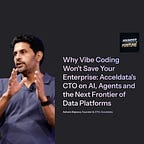
In a recent episode of the Founder to Fortune podcast, hosts Vidya Raman and Michael Raybman sat down with Ashwin Rajeeva, Co-Founder and CTO of Acceldata. Over the last six years, Acceldata created the data observability category and scaled into an enterprise platform powering tech stacks at the top Fortune 500 companies.
Ashwin’s perspective offers a masterclass for founders building in the age of AI. Here are the core insights on founder dynamics, enterprise growth hacks, and why the “vibe coding” revolution actually makes domain expertise more valuable, not less.
1. Shipping in 60 Days: Acute Pain Trumps Product Polish
In October 2018, four technical colleagues from Hortonworks set out to solve a massive problem in big data: when complex enterprise data pipelines broke, diagnosing the issue required manually collecting and shipping massive log files across the internet.
Two months later, in December 2018, they shipped their Minimum Viable Product (MVP).
October 2018: Idea & Team Assembly
        │
        ▼
December 2018: MVP Complete
        │
        ▼
Q1 2019: First Paying Enterprise Customers
How did an enterprise software company move that fast?
“Most customers would be willing to live with incomplete software if it solved a problem properly,” Ashwin explains. “The key driver is always pain. Someone who needs something now because something is at stake... You invested $4M or $5M into a platform. What’s $300K more just to make sure things work properly?”
The Takeaway for Founders: Don’t delay your launch trying to build a feature-complete surface area. If you target an acute, high-dollar pain point, enterprise buyers will happily tolerate a rough edge or two in exchange for immediate relief.
2. The Testing Growth Hack: Open Data Platform (ODP)
Early-stage enterprise startups face a classic chicken-and-egg problem: you need real environment testing to prove your software works, but you don’t have the capital to license or run expensive enterprise infrastructure.
Acceldata couldn’t afford proprietary Hadoop distributions to test their code against different versions of Java and OS environments. So they built their own open-source distribution called Open Data Platform (ODP), integrating the open-source Hadoop ecosystem, ClickHouse, and upstream libraries.
┌─────────────────────────────────────────────────────────────┐
│                 Acceldata Growth Synergy                    │
├──────────────────────────────┬──────────────────────────────┤
│ Open Data Platform (ODP)     │ Pulse (Observability)        │
│ • Free & Open Source         │ • 3x better performance      │
│ • Drop-in vendor replacement │ • Automated management       │
└──────────────────────────────┴──────────────────────────────┘
By making ODP free and open-source on GitHub, Acceldata gave enterprises a seamless drop-in replacement for expensive proprietary vendors. Even better, when customers used ODP, Acceldata’s flagship observability product (Pulse) performed 3x better because of custom automated plugins.
3. Co-Founder Physics: All-Technical Teams & The “No-Jerks” Rule
Conventional VC wisdom insists that founding teams must pair a business-minded hacker with a hustle-driven seller. Acceldata ignored this rule: all four founders were technical engineers.
So how did they avoid catastrophic co-founder drama?
Valuing Relationships Over Daily Battles: “This relationship is more important than the day-to-day,” says Ashwin. “If everybody believes in that, then you can find common ground... the small daily battles are not that relevant.”
Structure Over Chaos: Instead of running a friction-filled “move fast and break things” culture, Acceldata established early engineering structures—automated testing, local builds, clear CI/CD, and architecture docs—making scaling to 120+ engineers seamless.
The Unofficial “No-Jerks” Rule: The company enforces a strict standard of emotional discipline. Shouting, throwing tantrums, or erratic behavior during critical customer incidents is strictly unacceptable.
4. Why Vibe Coding Won’t Save Internal Enterprise Apps
With AI tools making code generation push-button simple, many enterprise teams assume they can simply “vibe-code” their own custom internal tools rather than buying vendor platforms.
Ashwin warns that this overlooks the 2-Year Irrelevance Trap:
“The fate of all internal software is becoming irrelevant after two years,” Ashwin notes. “You build this in about three months with all enthusiasm, and then it was built and delivered. Then you lost interest and moved on. Now there’s no one, and a bunch of people are still supporting it.”
While simple CRUD apps can be generated in a weekend, true enterprise platforms require:
Ongoing Security & Vulnerability Patching
Multi-Year Architectural Support
Navigating Massive AI Security Audits (where enterprise buyers issue 400- to 500-question compliance questionnaires)
5. The Real Future: Agentic Data Management (ADM)
The real value of AI in the enterprise isn’t writing simple web apps; it’s deploying autonomous business agents. However, an AI agent cannot dynamically adjust business strategies or detect anomalies without clean, unified context.
“If you really want to improve your business, you want an AI agent to go figure out which users are more eligible for payday loans... That means the AI brain needs access to all of this information,” Ashwin explains. “The need for AI to have access to enterprise data to make any useful agentic decision is going to be the key driver for everything.”
Final Thought for Founders
As code generation becomes commoditized, the supply of software will far outstrip its demand. Winning startups won’t be the ones who generate code the fastest. They will be the teams who deeply understand enterprise pain, enforce structural engineering discipline early, and provide the trusted context that AI agents need to operate.


